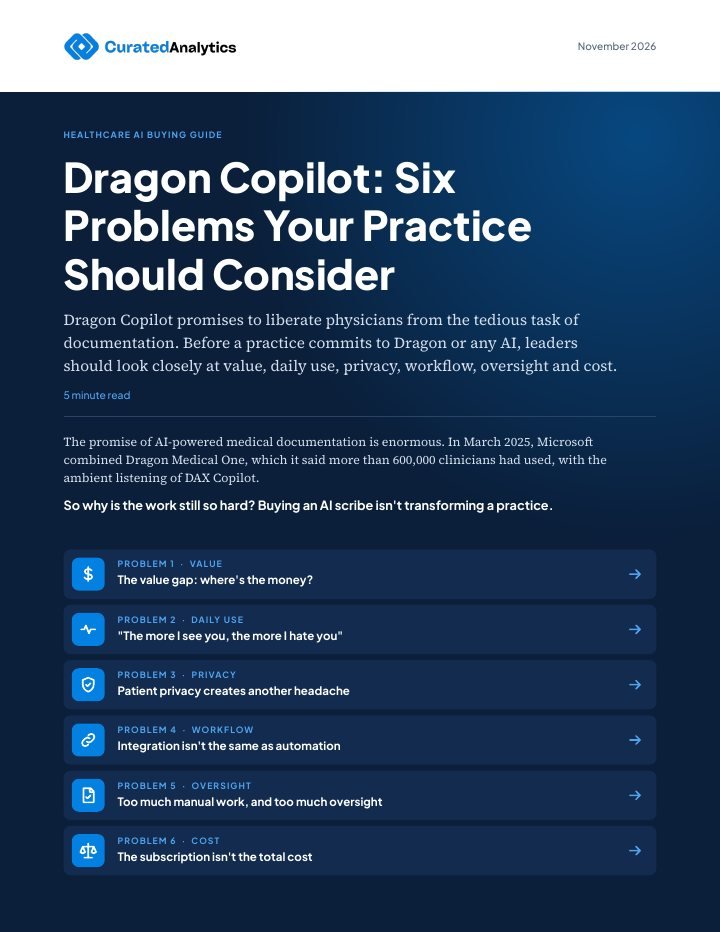
Dragon Copilot: Six Problems Your Practice Should Consider
Dragon Copilot promises to liberate physicians from the tedious task of documentation. Before a practice commits to Dragon or any AI, leaders should look closely at value, daily use, privacy, workflow, oversight and cost.
The promise of AI-powered medical documentation is enormous. In March 2025, Microsoft combined Dragon Medical One, which it said more than 600,000 clinicians had used, with the ambient listening of DAX Copilot.
So why is the work still so hard? Buying an AI scribe isn't transforming a practice.
Problem 1 · Value
The value gap: where's the money?
The biggest question isn't whether Dragon Copilot saves time. It's whether that time produces measurable financial returns.
In March 2025, the Peterson Health Technology Institute found that AI scribes appear to lessen burnout and the mental load of documentation, but that their financial impact for health systems was still unclear. Physicians may finish notes faster, but unless the practice increases patient capacity, improves coding accuracy or reduces operating costs, the savings may never reach the bottom line.
What AI saves
Minutes per note
Mental load
Documentation frustration
What reaches the bottom line
Added visits
More accurate coding
Less overtime
Lower turnover
More efficient charting isn't necessarily more profitable medicine.
Problem 2 · Daily use
"The more I see you, the more I hate you"
The real test of AI isn't the first impressive demonstration. It's the hundredth patient encounter. Dragon Copilot may delight physicians at first by drafting notes in seconds. Daily use can expose the friction: incorrect terminology, missing details, repetitive corrections, awkward EHR handoffs and additional review.
The published gains are real but modest. A University of Chicago study of ambient AI scribe users, published in JAMA Network Open in October 2025, found about 8.5% less time in the EHR per appointment, roughly 2.4 minutes, and no change in after-hours documentation time.
What improved
8.5% less EHR time per appointment
About 2.4 minutes saved per appointment
What didn't change
After-hours documentation time
The measure of success isn't how quickly AI creates a draft. It's how much easier the physician's whole workday becomes.
Problem 3 · Privacy
Patient privacy creates another headache
Medical conversations contain extraordinarily sensitive information. Practices need answers about recording consent, data storage, retention, access controls and whether protected health information is used to improve AI models.
Microsoft publishes some of those answers. Its documentation says Dragon Copilot keeps audio, transcripts and related data for up to 90 days, and that data is de-identified or pseudonymized before it is used for AI model improvement. Enterprise security features still don't replace the practice's own work: confirming the business associate agreement, patient consent, access rules and appropriate use.
Dragon CopilotMicrosoft's security, encryption and retention rules
What the practice still has to manage
Patient consent
Business associate agreement
Who can access notes
Other AI tools staff use
Retention policy
Microsoft can secure its product. Only the practice can secure its process.
Problem 4 · Workflow
Integration isn't the same as automation
Connecting an AI scribe to an electronic health record doesn't mean it completes the workflow. Documentation still has to connect to diagnoses, orders, referrals, coding, billing and follow-up care.
When those steps stay disconnected, staff bridge the gaps by hand. A practice can end up with an expensive AI system sitting inside an inefficient process.
AIDrafts the note
StaffOrders, referrals and coding
StaffBilling and follow-up
A faster note doesn't fix a slow process.
Problem 5 · Oversight
Too much manual work, and too much oversight
Doctors remain responsible for reviewing AI-generated notes. They must catch omitted findings, incorrect medications, misleading summaries and unsupported clinical statements. Microsoft's own guidance notes that some sections of a draft may be empty if the information wasn't captured in the recording.
Independent research shows why review matters. A UC Davis Health study of 356 ambient AI notes, published in JMIR Medical Informatics in 2026, found omissions in 18% and hallucinations in 11.5%. Most errors were mild to moderate, but 5.3% of notes had errors rated as serious, and the authors concluded that careful clinician review remains essential.
AIDrafts the note
PhysicianChecks every finding
PhysicianSigns the record
Human oversight is essential. The real question: how much work does AI actually eliminate?
Problem 6 · Cost
The subscription isn't the total cost
Microsoft hasn't published commercial subscription prices for Dragon Copilot, so practices have to get a quote. Software fees are only the beginning.
Add training, implementation, integration, staff support, workflow redesign and quality assurance, and the price moves from Toyota to Ferrari. Without a baseline for documentation costs and measured results after go-live, practice executives can't know whether the investment pays.
What the quote covers
The subscription
What the practice also pays for
Training
Implementation
Integration
Staff support
Workflow redesign
Quality assurance
Measure the whole bill and the whole result, not just the license.
A documentation tool isn't an AI strategy.
Dragon Copilot may be an effective documentation tool. But practices need to measure the complete workflow, from patient encounter through collected revenue, not just the minutes saved drafting a note. The opportunity isn't only better AI software. It's better management of the entire process.
That management doesn't have to come from a full-time executive. A Fractional Chief AI Officer can set a practice-wide strategy, evaluate competing technologies independently, put privacy and clinical safeguards in place and document financial results.
Curated Analytics helps healthcare practices find high-value AI opportunities, evaluate technology independently, implement secure workflows and measure results.
Curated Analytics is independent of Microsoft and Nuance and is not affiliated with or endorsed by them. Microsoft, Dragon Copilot, DAX Copilot and other names are trademarks of their respective owners. This paper is general commentary based on public information available in November 2026. Studies cited examine ambient AI scribes generally unless noted. Pricing and product features may change. It is not medical, legal, compliance or purchasing advice.