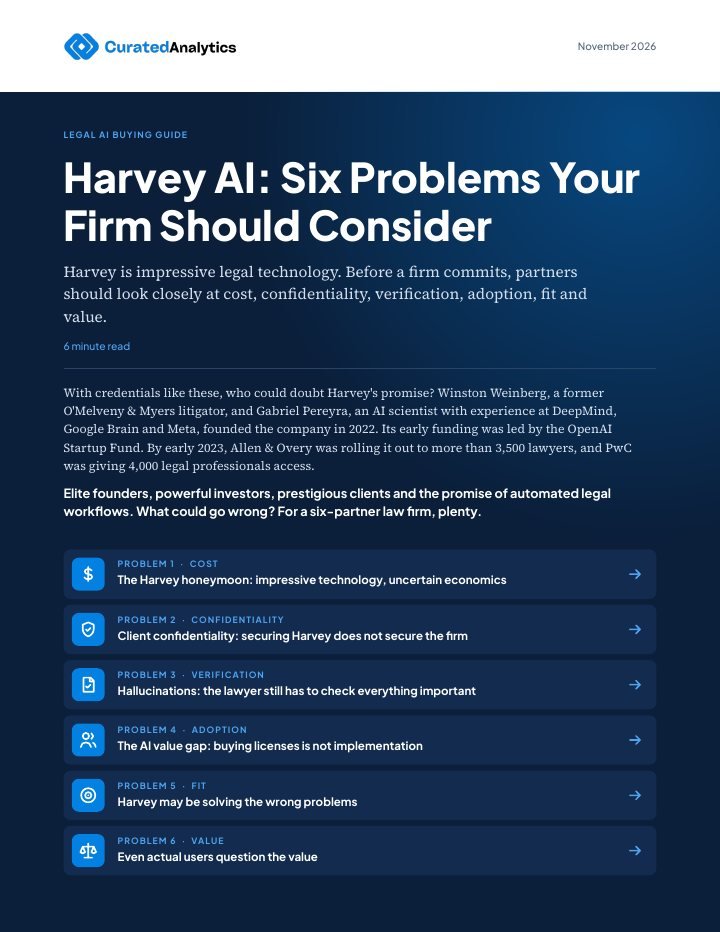
Harvey is impressive legal technology. Before a firm commits, partners should look closely at cost, confidentiality, verification, adoption, fit and value.
With credentials like these, who could doubt Harvey's promise? Winston Weinberg, a former O'Melveny & Myers litigator, and Gabriel Pereyra, an AI scientist with experience at DeepMind, Google Brain and Meta, founded the company in 2022. Its early funding was led by the OpenAI Startup Fund. By early 2023, Allen & Overy was rolling it out to more than 3,500 lawyers, and PwC was giving 4,000 legal professionals access.
Elite founders, powerful investors, prestigious clients and the promise of automated legal workflows. What could go wrong? For a six-partner law firm, plenty.
Problem 1 · Cost
The Harvey honeymoon: impressive technology, uncertain economics
Harvey arrived with an irresistible proposition: automate expensive legal work, accelerate research, review documents and produce drafts in a fraction of the time required by attorneys. For firms facing rising labor costs, demanding clients and increasing competition, the appeal is obvious.
The economics are harder. Harvey does not publish its pricing. Third-party reports commonly describe about $1,000 to $1,200 per seat per month, with minimums of around 20 seats. At the low end of those reports, that is about $240,000 a year before onboarding, setup, maintenance and customization.
$1,000per seat, per month
×
20minimum seats
×
12months
=
$240,000per year, before onboarding
Low end of third-party reports. Harvey does not publish its pricing.
At that price, who is Harvey actually designed for?
Problem 2 · Confidentiality
Client confidentiality: securing Harvey does not secure the firm
Harvey offers enterprise security and data protection features designed for legal practice. Those safeguards are an advantage over uncontrolled use of consumer AI tools.
But Harvey cannot protect information that employees enter into other applications or move through insecure workflows. Lawyers may use ChatGPT, document management platforms, email, research databases and other AI systems at the same time. Every connection and transfer raises questions about authorization, access, retention and confidentiality.
Harvey cannot oversee what it cannot see. The firm still needs rules for every AI tool and workflow.
Problem 3 · Verification
Hallucinations: the lawyer still has to check everything important
Harvey's legal research capabilities are impressive, and its integration with authoritative legal sources is valuable. But a lawyer cannot file impressive. A lawyer must file accurate.
In Hill v. Foundation Media LLC, a federal judge in the Southern District of New York questioned quotations and a citation in a filing. Counsel attributed the problem to AI-generated material that was not checked before filing and said the firm had used Harvey tools. The reporting does not establish that Harvey caused the specific errors. The judge declined to impose sanctions, but stressed that lawyers remain responsible for what they file and raised concerns about how junior lawyers will develop their skills.
AIProduces the draft
AttorneyChecks every source
AttorneySigns and files
Harvey cannot sign the filing. Your attorney does. Budget for verification, not just for software.
Problem 4 · Adoption
The AI value gap: buying licenses is not implementation
Adoption is not just a Harvey problem. It is an AI problem. Thomson Reuters has described an AI impact gap in law firms, where leaders can mistake software purchases and scheduled training for real change in daily work. If only half the seats are used, the cost per active user doubles.
An August 2026 G2 review from a legal document review specialist praised Harvey's contract review and its integration with Word and Outlook, while asking for better document management integration and more customization. Forcing more usage is not necessarily the answer. A product can be highly valuable for some practice groups and poorly suited to others.
10 of 20 seats in use$1,000 to $2,000monthly cost per active user
Illustration using the low end of reported pricing.
Licenses do not guarantee adoption, productivity or profitable use.
Problem 5 · Fit
Harvey may be solving the wrong problems
Harvey emphasizes legal research, drafting, due diligence and large-scale document analysis. Those capabilities can be valuable, particularly for firms handling complex litigation or major transactions.
But consider a 30-person firm with six partners. Its daily frustrations may involve prospective clients who never receive a follow-up call, slow onboarding, incomplete document collection, repetitive client communications, unpaid invoices, inconsistent matter tracking and partners spending time on administration. Improving those processes may produce a greater financial return than accelerating sophisticated legal research.
What Harvey emphasizes
Legal research
Drafting
Due diligence
Large-scale document analysis
What may slow a six-partner firm
Missed follow-up calls
Slow client onboarding
Incomplete documents
Unpaid invoices
Inconsistent matter tracking
Harvey doesn't know everything about what you really need.
Problem 6 · Value
Even actual users question the value
The criticism is not limited to people who have never tried Harvey. A September 2026 G2 reviewer from a business with 50 or fewer employees gave Harvey four out of five stars and praised its document analysis, while identifying high costs, restricted access, hallucination risk and continued dependence on human oversight.
Public commentary is mixed. Some legal professionals question pricing, accuracy and whether less expensive general-purpose AI could handle enough of the work. Others strongly defend Harvey's specialized research, document review and governance capabilities.
What users praise
Document analysis
Specialized research
Governance capabilities
What users question
High cost
Restricted access
Hallucination risk
Dependence on human oversight
A product can be useful, even impressive, and still be the wrong investment for your firm.
The problem is not Harvey. AI does not take responsibility for anything.
Harvey has demonstrated that AI can perform valuable legal tasks at remarkable speed. But the challenges facing law firms are much larger than research and drafting. AI needs supervision at every step, and no single vendor can solve all of these problems.
Law firms need independent leadership that connects AI capabilities with professional standards, employee development, operating processes, financial objectives and market opportunities. That leadership does not have to come from a full-time executive. A Fractional Chief AI Officer can establish a firmwide strategy, evaluate competing technologies, manage implementation and document financial results.
Curated Analytics helps law firms identify high-value AI opportunities, evaluate technology independently, implement secure workflows and measure results.
Curated Analytics is independent of Harvey and is not affiliated with or endorsed by it. Harvey and other names are trademarks of their respective owners. This paper is general commentary based on public information available in November 2026. Pricing and product features may change. It is not legal, ethics or purchasing advice.